

Put your householdon autopilot.
Homeprint holds everything your household owns, owes, and renews. We track the dates, find you better rates, and manage the paperwork — so you don't have to.
Built on the things a shared calendar can never hold
- Bank-level encryption
- Your real documents
- What it's all worth
- Shared with your household
Someone in your house is holding all of this.
Every one of these arrived through a different door — an email, a letter, a sticker, a contractor's invoice. None of them live anywhere. Which means the only record this house has, including what it's worth and what you've put into it, is inside one person's head.
- Home insurancein a letter you opened once
- Passportsin a drawer, somewhere
- Furnace serviceon a sticker on the boiler
- Dental benefitsin an email from January
- Vehicle registrationin a notification you swiped away
- School formsat the bottom of a backpack
- Annual subscriptionsin a receipt you never opened
- Property taxon the kitchen counter
- Extended warrantyin the box it came in
- Mortgage renewalin something your broker said
- Travel insurancenowhere at all
- Appliance registrationon a card you meant to send
- What it's worth nowa listings tab you keep open
- The roof's agea 2019 inspection report
- The furnace modela sticker in the basement
- Last year's $14k renoan email from the contractor
- …and the dozen you haven’t thought of yet
None of it feels urgent. All of it is either costing you money now, or about to.
It remembers, it tells you, then it helps.
Most tools stop at the reminder. The reminder was never the hard part.
- Home insuranceRenews Aug 24Bosch dishwasherWarranty to Aug 28Maya — passportExpires Mar 4
It remembers what you own
Add a policy, a document, an appliance, an account. Homeprint pulls out the dates, terms, providers, serial numbers, what you paid and what it's worth now — so the details stop living in your head.
- Today3Insurance renewalPassport renewalDental — book by Fri
A daily feed shows what's next
One calm list, in the order that matters: what's due this week, what expires this month, and what needs a decision before it costs you something.
- Read your renewal notice
Premium $2,140 · up $340· auto-renews Aug 24
Get quotesRemind me Aug 18Then it helps you get it done
Compare the renewal before it auto-renews. Pull the policy number for a claim. Get the mortgage paperwork together. Send a contractor the exact make, model and age before they quote, instead of a photo and a guess. The step after the reminder is the one that actually costs you an afternoon.
The point isn't the reminder. It's what the reminder is worth.
Money back on the renewals that cost the most, the paperwork done for you, offers that actually apply, and a running total of what your household spends. See the benefits in full.
- Renewals
Never auto-renew at a loss
When your insurance or mortgage is up, we don't just remind you. We automatically compare your exact coverage against the market to ensure you aren't getting hit with a loyalty penalty.
- Mortgage
The most expensive date your household has
A renewal arrives once every few years, usually with one phone call and no time to think. Homeprint starts the conversation months ahead, with your numbers already assembled — so you're comparing from a position of having options.
- Upkeep
The cheap repair and the expensive one are the same repair
A serviced furnace costs a few hundred a year. An unserviced one becomes a replacement in January at the emergency rate. Homeprint knows what you have, how old it is and when it was last touched — so the work happens while it's still the cheap version.
- Paperwork
The forms stop asking what Homeprint already knows
Every mortgage application, insurance quote and warranty claim wants the same twenty facts about your home. Homeprint holds them, so the form arrives filled in and the quote request goes out with the model number and service history already attached.
- Offers
Benefits that apply, because it knows what you own
Deals and member benefits from local and national brands, matched against what your household genuinely has — the 2019 furnace, the policy renewing in August — rather than broadcast at you and left to sift.
- Expenses
What your household actually spends, in one figure
Every provider, every account number, and what you pay each one — totalled for the year. Most households have never seen that number in one place, which is exactly why it drifts.
What Homeprint tells you, before you'd have thought to ask.
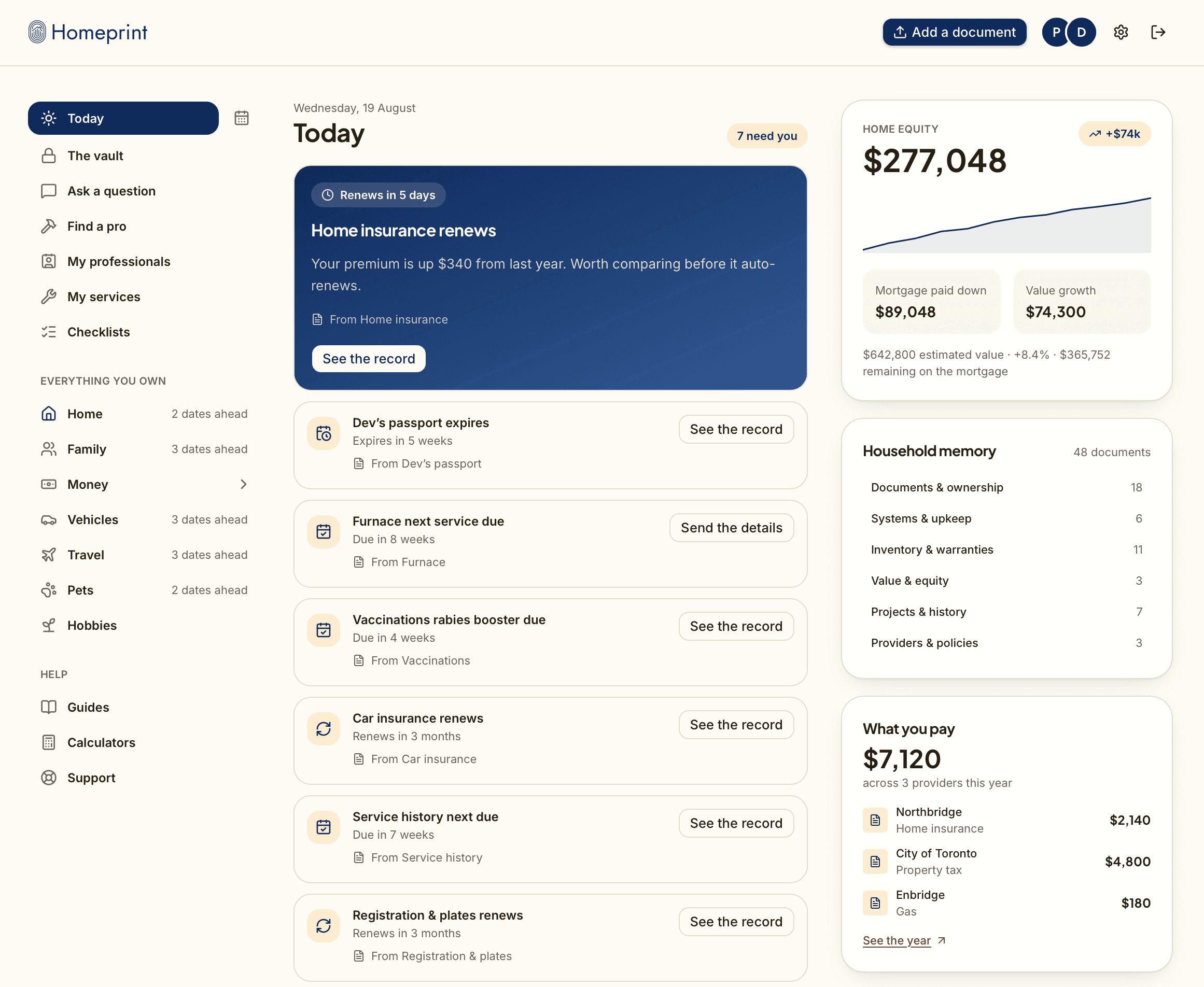
This is the real thing — one calm feed of what needs you next, with your home's equity, your documents, and what you pay sitting right beside it.
Zero data entry
No forms.No spreadsheets.No typing it all in.
Homeprint sets itself up from the paper your household already has.
Send it in
Forward an email or snap a photo of a document.
We read it
We automatically extract the dates and costs.
You stay ahead
You get alerted before it costs you money.
Send the first one in now.
Your home is where it started, not where it stops.
A household is a house, a set of finances, a few people, and a hundred dates none of you agreed to keep track of. Homeprint holds all of it in one memory — so the passport, the property tax and the furnace service arrive in the same calm list instead of four different places.
- The house — deed, insurance, systems, warranties, upkeep and what it's worth
- The money — mortgage renewal, subscriptions, tax instalments, what you pay each provider
- The people — passports, benefits, school and medical dates
- Vehicles, travel and pets, with the same treatment
A folder can't act. A calendar can't know.
Storage apps hold your documents and wait for you to come looking, which is exactly why people open them twice a year. Calendars only hold what somebody remembered to type. Homeprint is the one place where the record and the action are the same product: the file knows the date, so the date arrives on its own.
- Your policy knows its own renewal date — Homeprint reads it, you don't
- Your home's value updates whether or not you think to check
- Warranties, serial numbers, and receipts stay attached to the appliance
- Every reminder traces back to a real document you can open
- Every job you finish goes back onto the record for the next one
Homeprint has a vault and a calendar. Neither one is the interesting part.
Built for the person everyone else asks.
If you're the one who knows where the birth certificates are and when the insurance renews, this was built for you.

Homeowning families
A mortgage, a furnace, two kids, a car, and a hundred renewal dates. The more your household owns, the more there is to hold — and the more Homeprint has to work with.

The one carrying the load
You never volunteered to be the family's memory. Homeprint takes the remembering, so the job stops being invisible — and stops being only yours.

Households sharing it
Invite your partner. What one person has been holding alone becomes something you can both see, with the real documents sitting right behind it.
You're trusting us with the real thing.
Deeds, policies, passports, receipts. We've been holding documents like these since day one, and we treat them accordingly.
Bank-level encryption
Your documents are protected in transit and at rest — the standard Homeprint has held since day one.
You choose who sees what
Records are private to you unless you share them — with a partner, an agent, or nobody at all.
Your documents stay yours
Everything you upload belongs to you. Download it or delete it whenever you like.
The record you already have
Everything in your vault is the asset's file — and it's what every reminder, valuation and comparison is built from. Nothing was moved to make room.
What's hiding in your house?
Two questions, no email required — just an honest look at what's already expiring around you.
You likely have 2 expiring warranties and an upcoming mortgage renewal. Homeprint can find them for you in 5 minutes.
At this age the original appliances start coming off warranty one by one — usually without telling you.
Your home's permit history. Free.
Every renovation that ever pulled a permit — the deck, the basement, the rewiring — is sitting in a municipal database you've probably never looked at. Homeprint pulls the building permits for your address and puts them on your home's record, covering most major Canadian cities.
- Every permitted job on your property, with dates and declared values
- The history from before you owned it — work you'd otherwise never know about
- Proof of work when insurance, an appraisal, or a sale asks for it
- Free with your account — you don't need to upload a thing to start
Available wherever we have municipal permit data — most major Canadian cities, with more added regularly. Search your home’s history.

For the first time, everything about our house lives in one place. It's the first thing I'd set up in a new home.
Alexi Johnston
Homeowner & real estate agent
The things people ask first
Your household should keep its own records.
Create your free account and give everything you own, owe and renew one place to live.